Cestio vs Potto: which AI meal planner is worth paying for?
Cestio vs Potto in 2026: Potto costs $9.99 a week. Cestio is free to download, free for 3 days and then costs $4.99 — and adds household sharing, 7 languages and European supermarkets. A feature-by-feature comparison of price, plans, shopping lists and photo tools.
The short version
- Cestio is free to download, and every feature is free for 3 days. After that it costs $4.99/week or $39.99/year in the US, and €2.99/week or €19.99/year in Europe.
- Potto costs $9.99 a week — about $40 a month and more than $500 a year, twice Cestio's price.
- Cestio adds what Potto does not have: one plan and one shopping list shared live with your partner or family, full translation into 7 languages, and local supermarkets in Spain, Germany, France, Italy, Portugal and Greece.
- Both plan a full week around your budget and diet, both turn a fridge photo into recipes and both estimate calories from a plate photo. For most people Cestio is the better and cheaper choice.
Cestio and Potto solve the same Sunday-night problem: nobody wants to decide what to eat for seven days, and the shopping list ends up scribbled on an envelope. Both apps let AI plan the week, both turn that week into a supermarket list, and both let you point a camera at your fridge or your dinner.
The difference is what you pay for it and who it is built for. Potto charges about twice as much as Cestio and is designed for one person shopping in English. Cestio is built for households, in seven languages, at a lower price.
The short answer
Side by side
| Cestio | Potto | |
|---|---|---|
| Price | Free download, every feature free for 3 days, then $4.99/week or $39.99/year | $9.99/week |
| Cost of one year | $39.99 | About $520 at $9.99/week |
| Price in Europe | €2.99/week, €4.99/month or €19.99/year | No European version |
| Weekly plan | 21 meals — breakfast, lunch and dinner, 7 days | Full week of recipes |
| Regenerate one meal | Yes, without touching the rest of the week | Yes |
| Calories and macros per meal | Yes — calories, protein, carbs and fat on every planned meal | Cook times and cost estimates |
| Shopping list | Aisle-sorted, with a running estimated total | Sorted for your store, with cost estimates |
| Shared with your household | Yes — live, with items assignable to a person plus a push notification | No — no account, so no sync between people |
| Fridge photo → recipes | Yes (Fridge Chef) | Yes |
| Plate photo → calories | Yes (Calorie Snap), with a daily goal and history | Yes |
| Budget | Set a weekly spend; the plan is built inside it | Set a weekly spend |
| Languages | 7 — English, Spanish, French, Portuguese, German, Italian, Greek | English only |
| Countries with built-in supermarkets | Spain, UK, US, Germany, France, Italy, Portugal, Canada, Australia, Greece | US, UK, Canada, Australia |
| Platforms | iPhone and iPad | iPhone only |
Price: Cestio costs half as much
Potto costs $9.99 a week, and the weekly plan is the only option. That is about $40 a month, or more than $500 a year.
Cestio is $4.99 a week in the US, or $39.99 for a full year — about $3.33 a month. In the euro zone it is €2.99 a week, €4.99 a month or €19.99 a year. A year of Cestio costs less than one month of Potto.
Cestio is free to download, and every feature is free for 3 days — the full week of 21 meals, the recipes, the shared shopping list, Fridge Chef and Calorie Snap — before you pay anything.
Where Cestio is better
1. It is built for two or more people
In Cestio, one person creates a household and shares a link. From then on everyone sees the same plan and the same shopping list, updating live. Assign an item to someone and they get a notification — “Can you buy the eggs?”. Tick off the milk and it greys out on every phone.
Potto works without an account, which also means there is nothing to share: no household, no second phone, no plan waiting for you on your iPad.
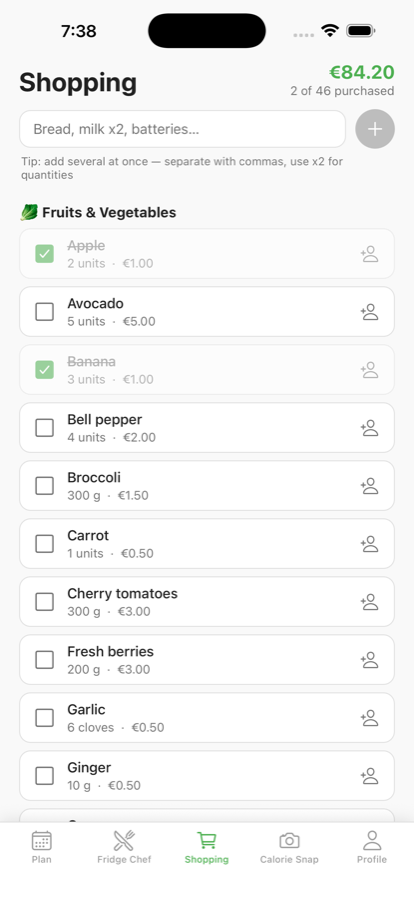
2. It speaks your language, and knows your supermarket
Cestio is translated into seven languages, including the parts that matter: meal names, recipes and the shopping list, not just the buttons. Onboarding offers the chains that exist where you live — Mercadona, Dia and Eroski in Spain; Rewe, Edeka and Penny in Germany; Continente and Pingo Doce in Portugal; Esselunga and Conad in Italy; Sklavenitis in Greece — and prices come back in your currency.
If your shop is not on the list, you type it in and the plan is built around it anyway. Potto is English-only and covers stores in the US, UK, Canada and Australia.
3. It plans around what you refuse to eat
Both apps take diets and allergies. Cestio adds a separate step for taste: the foods you love and the foods you never want to see. Aubergine, coriander, blue cheese — it stays out of all 21 meals, every week.
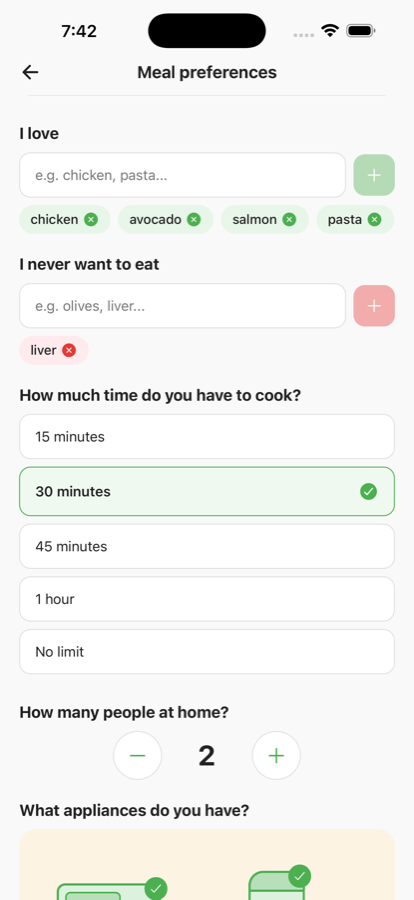
4. Macros on every meal
Every meal in a Cestio plan shows calories, protein, carbs and fat, and diets can be combined — vegetarian and gluten free, low carb and dairy free — instead of picking just one.
What both apps do
- Fridge photo to recipes. Photograph a shelf and get meals you can cook right now.
- Photo calorie logging. Estimate calories and macros from a picture of your plate.
- Budget-first planning. Tell the app what you want to spend and it plans inside that number.
- Estimates, not receipts. Neither app is connected to live supermarket prices, so treat totals as a guide.
Is Potto worth $9.99 a week?
For most people, no — not when Cestio plans the same week, writes the same aisle-sorted list and does the same fridge and plate photos for $4.99 a week or $39.99 a year. On top of that you get household sharing, seven languages and European supermarkets.
Cestio also has no ads, no affiliate links and no sponsored ingredients steering what lands in your trolley. The subscription pays for the AI that builds your plan, and that is all it pays for.
How to test Cestio properly
- Set your real budget, not an aspirational one.
- Enter your actual dislikes at set-up — most disappointment with meal planners comes from food you were never going to cook.
- Invite whoever else does the shopping, and take the list to one shop.
- At the end of the week, count how many of the 21 meals you cooked. Anything above 12 or 13 means the planner fits you.
Frequently asked questions
- How much does Potto cost?
- Potto costs $9.99 per week, around $40 a month. Cestio is free to download, free for 3 days, and then costs $4.99 per week or $39.99 per year.
- Is Cestio free?
- Cestio is free to download, and every feature — weekly AI plans, the shared shopping list, Fridge Chef and Calorie Snap — is free for 3 days. After that it costs $4.99 a week or $39.99 a year, half the price of Potto.
- Is Cestio or Potto cheaper?
- Cestio. It costs $4.99 a week against Potto's reported $9.99, and Cestio's yearly plan is $39.99 — less than a single month of Potto. In Europe Cestio is €2.99 a week or €19.99 a year.
- Can Potto share a shopping list with my partner?
- No. Potto works without an account, so there is nothing to sync between two phones. Cestio's household feature shares one plan and one shopping list live, with items assignable to a specific person who gets a push notification.
- Does Potto work in Spain or Germany?
- Potto is in English and its supermarket coverage is the US, UK, Canada and Australia. Cestio includes supermarkets for Spain, Germany, France, Italy, Portugal and Greece and is translated into seven languages.
- What is the best alternative to Potto?
- Cestio is the closest alternative to Potto and costs half as much. It has the same weekly AI plan, aisle-sorted shopping list, fridge photo recipes and photo calorie logging, plus household sharing, 7 languages and European supermarkets.
- Are Cestio and Potto available on Android?
- As of September 2026 both are App Store apps. Cestio runs on iPhone and iPad, Potto on iPhone only. Cestio's Android version is in testing.