How to plan a whole week of meals on a fixed grocery budget
A repeatable method for planning seven days of meals inside a set weekly spend — the anchor system, ingredient overlap, where the money actually leaks, and a worked €70 example for two people.
The short version
- Budget cooking fails on logistics, not on recipes. The three things that blow a grocery budget are extra trips to the shop, ingredients bought for exactly one meal, and food that rots before you cook it.
- The anchor method works: pick 2–3 proteins, 2 carb bases and 1 flexible vegetable for the whole week, then build every meal from that shortlist so ingredients get used two or three times.
- Plan the leftovers deliberately. Cooking a double batch of one component — rice, roast chicken, a tomato base — covers two more meals at close to zero extra cost.
- Then shop once, from one written list, sorted by the aisles of your actual supermarket. Every additional trip is where the impulse spend happens.
Most advice about eating well on a budget is a list of cheap ingredients. That is not the problem. Lentils are cheap and everyone knows it. The problem is that a week of meals is a logistics exercise, and almost nobody runs it as one.
Here is a method that works whether your number is €50 or £120, and a worked example at the end.
Step 1: find your real number, not your ideal number
Look at your last four weeks of grocery spending — bank app, three minutes — and add the corner-shop trips and the “just grabbing lunch” ones. That total divided by four is your real number. Whatever you were about to type as your budget is probably 25–30% below it.
Set your weekly budget at your real number minus 10% for the first month. A plan built at a fantasy figure gets abandoned by Wednesday, and you learn nothing.
Step 2: the anchor method
Do not plan 21 individual meals. Plan a shortlist, then assemble meals from it. For one week, pick:
- 2–3 proteins. For example: a whole chicken, a pack of eggs, one bag of dried lentils or chickpeas.
- 2 carb bases. For example: rice and pasta. Or potatoes and bread.
- 1 flexible vegetable you buy in bulk. Whatever is genuinely cheap that week — cabbage, carrots, courgettes, onions.
- 2–3 “make it taste like somewhere” kits. Soy + garlic + ginger. Tomato + oregano + olive oil. Cumin + paprika + lemon. These cost almost nothing and are the difference between variety and monotony.
Every meal that week is a combination of those. The same chicken becomes a roast on Sunday, a rice bowl on Monday and a soup base on Tuesday. That is not repetitive — it is the same ingredient wearing three different flavour kits.
Step 3: cook once, eat twice — on purpose
Leftovers are usually an accident. Make them a plan. Doubling a component rather than a whole dish is the trick, because a component recombines and a full dish does not:
- Double the rice on Monday → fried rice on Wednesday.
- Roast two trays of vegetables → half go in a traybake, half go into a soup or a grain bowl.
- Make a big pan of tomato base → pasta one night, shakshuka for breakfast, a braise later in the week.
- Cook the whole bag of lentils → soup, then a salad, then a filling for something.
Three doubled components can cover five or six meals across a week, and the marginal cost is close to zero.
Step 4: know where the money actually leaks
| The leak | What it costs | The fix |
|---|---|---|
| Multiple shop trips | Impulse buys on every visit, and they compound | One written list, one trip, and stick to the list |
| Single-use ingredients | A jar or bunch used once, then thrown away | The two-meal rule from Step 2 |
| Fresh produce bought optimistically | The most common thing people bin | Buy fresh for the first 3–4 days; frozen or tinned for the back half of the week |
| No plan for Thursday | The takeaway that costs a fifth of the weekly budget in one go | Deliberately plan the easiest, laziest meal of the week for the day you know you'll crash |
Step 5: write the list in the order of the shop
A list written in the order you thought of things means walking the supermarket three times and passing the biscuits on every lap. A list grouped by aisle — fruit and veg, dairy, meat and fish, freezer, cupboard — is a single sweep. It sounds trivial. It is worth more than any coupon.
A worked example: €70 for two people, seven days
Anchors: whole chicken, 12 eggs, 500 g dried chickpeas, rice, pasta, a big bag of onions and carrots, cabbage, tinned tomatoes, frozen peas, yoghurt, cheese, bread, olive oil, and the three flavour kits.
- Sunday — roast chicken, roast carrots and potatoes. Bones go straight into a pot for stock.
- Monday — chicken and rice bowl with the soy-garlic-ginger kit and quick-pickled cabbage.
- Tuesday — chickpea and tomato stew with the cumin-paprika kit, on the same rice.
- Wednesday — fried rice with peas, egg and the last of the chicken.
- Thursday — the lazy night: pasta with the tomato base, cheese on top. Fifteen minutes.
- Friday — chickpea salad with yoghurt, lemon and whatever fresh vegetable survived.
- Saturday — soup from the chicken stock plus cabbage and carrots, with bread.
Breakfasts run on eggs, yoghurt and bread throughout. One chicken, one bag of chickpeas and one dozen eggs did most of the week's protein, and nothing on the list appeared only once.
The honest problem with doing this manually
The method works. Running it every Sunday for years does not, for most people. It is 30–45 minutes of genuine thinking — checking what overlaps, adding up rough costs, rewriting the list in aisle order — and it is the first thing to go on a busy week.
That is precisely the part software should take over.
What Cestio does with this
Cestio runs exactly this method automatically. You give it your weekly budget, your supermarket, your diets and allergies, how long you're willing to cook and which appliances you own. It builds 21 meals inside that budget, deliberately reusing ingredients across the week so nothing is bought for a single meal, and hands you the shopping list already grouped by the aisles of your shop, with a running estimated total.
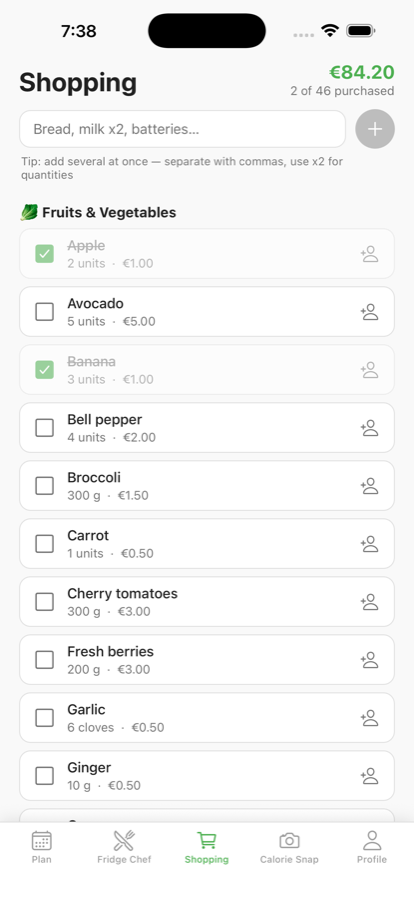
If more than one person in your house shops, they see the same list live and you can hand them specific items. And on the Thursday when the plan falls apart anyway, Fridge Chef turns a photo of your fridge into something you can cook in the next twenty minutes — which is usually what actually stands between you and a takeaway.
Frequently asked questions
- How much should I budget for groceries per person per week?
- There is no universal figure — it depends entirely on your country, your city and whether you eat meat. The useful approach is not to copy a number from an article but to measure your own last four weeks, then set your target about 10% below that and adjust. A budget you can actually hit teaches you more than an aspirational one you abandon.
- What's the single most effective way to spend less on food?
- Shop once a week from a written list, in one trip. Every extra visit to a supermarket is an opportunity for unplanned spending, and those trips compound faster than any individual ingredient swap saves.
- Does meal planning actually reduce food waste?
- It does, when the plan reuses ingredients across several meals rather than treating each dinner as a standalone recipe. Waste mostly comes from buying an ingredient for one dish and never opening it again — which is why the two-meal rule matters more than buying cheaper brands.
- Can an app plan meals inside a specific budget?
- Yes. Cestio takes your weekly spend as an input and builds the plan inside it, showing a running estimated total on the shopping list. The figures are estimates modelled on typical prices in your country and currency, not live supermarket pricing, so treat them as a guide.